
Armstrong County Release Records
Armstrong County does not operate the jail that currently houses its detainees. The Armstrong County Sheriff directs all inmate questions to Carson County Jail in Panhandle. This cross-county arrangement divides the record trail. Carson documents admission, physical departure, and any destination code entered in its jail system. Armstrong law enforcement holds its arrest and investigative records, while the combined Armstrong County and District Clerk keeps the court papers that explain bond, dismissal, sentence, jail credit, or community supervision.
“Released” must be tied to an agency and a date. Someone can leave Carson County Jail on bond, after time served, on a court order, or for probation. The same jail departure can instead be a transfer to another jail, TDCJ, federal custody, or immigration custody. A person who leaves the live custody system may no longer appear in a current search. That absence alone does not prove return to the community. The time-stamped jail record and the signed court order are the strongest pair for an Armstrong case.
Armstrong County Release Types
The label attached to a departure controls where the next useful record will appear. Bond ends that period of pretrial confinement but does not dismiss the charge. Time served or sentence complete refers to credit and sentence accounting. Probation, called community supervision in Texas law, is court ordered and managed locally. Parole and mandatory supervision follow release from TDCJ prison while the sentence continues. Discharge means the state sentence obligation has ended.
| Release type | What it means | Next record to check |
|---|---|---|
| Bond or court order | The person left pretrial custody subject to the case or order. | Carson release entry and Armstrong court file |
| Time served | Credited confinement completed the ordered jail term. | Signed judgment, jail-credit record, and release time |
| Probation | A court ordered community supervision. | Armstrong case file and local CSCD |
| Parole or mandatory supervision | TDCJ prison custody ended conditionally. | TDCJ status and assigned parole office |
| Transfer | Carson custody ended, but another agency took custody. | Destination agency or facility |
| Discharge | A TDCJ sentence obligation ended. | TDCJ incarceration history or discharge information |
A coded field may not be self-explanatory. Ask the custodian for the code definition and destination. That small detail prevents a transfer from being reported as a community release.
Armstrong Release Record Fields
There is no single universal Texas “release record.” A request may return a booking sheet with a release block, a booking-out entry, a custody log, a bond release, a transfer record, or attached court papers. Carson has not published a sample field dictionary, so the following are fields to request rather than a promise that each will be released in every case.
| Field | What it shows |
|---|---|
| Name and identifiers | Connect the event to the correct person and reduce common-name errors. |
| Booking number | Links the departure to a specific admission. |
| Admission date and time | Marks when the jail accepted custody. |
| Release date and time | Records when Carson ended that custody event. |
| Release type or reason | May identify bond, time served, order, or transfer. |
| Destination | Shows community release or the receiving custodian when recorded. |
| Charge, hold, or case | Connects the jail entry to Armstrong court or warrant records. |
| Bond information | Identifies the bond route without proving dismissal. |
Some information can be redacted or withheld under a legal exception. Juvenile, medical, sealed, and expunged material receives special treatment. When a release code is abbreviated, request the code sheet or definition rather than guessing.
Request Armstrong Release Records
Texas Government Code Chapter 552 covers access to existing public information, subject to exceptions. Because the arrest and jail exit occur in different counties, one broad request sent to a single office can miss half the trail. Split the request by record creator. The Armstrong public-information page accepts written requests through the listed delivery channels and asks for a clear description.
- Identify the person with full name, birth date if known, approximate arrest date, and Armstrong case number.
- Ask Armstrong Sheriff for its arrest, booking, transport, and responsive photograph records.
- Ask Carson Sheriff or Jail for the booking-in and booking-out, exact release or transfer time, type, destination, and code definitions.
- Ask the Armstrong clerk for the docket and signed bond, dismissal, judgment, sentence, credit, probation, or revocation papers.
- Request an electronic copy and a narrow date range, then review any cost estimate before work begins.
Armstrong posts a charge of ten cents per standard paper page. A request exceeding fifty pages may add allowed labor, overhead, retrieval, and shipping costs. The county may provide an estimate for a broad or nonstandard request. No fixed delivery time should be promised. Texas rules about seeking an Attorney General decision are not a guarantee that records arrive within ten business days.
Armstrong Release Record Retention
Texas Government Code Chapter 552 establishes access to public information and preserves basic information about an arrested person, arrest, or crime even when some law-enforcement material falls under an exception. Texas State Library Local Schedule PS item PS4200-10 sets a minimum retention period for prisoner commitment, transport, booking-in/out, transfer, and release records of release or transfer plus two years. This is a records-retention floor. It does not require a public web roster, and it does not mean that a name will stay visible online for two years.
Expunction and nondisclosure are different. Texas Code of Criminal Procedure Chapter 55A governs expunction, which can direct covered records to be returned or destroyed. Government Code section 411.071 and following provisions govern orders that restrict public dissemination through specific routes. Release alone does not establish eligibility for either remedy.
Armstrong Release Court Records
Armstrong combines county and district clerk functions. The Armstrong County and District Clerk is at 100 Trice Street in Claude and is open Monday through Thursday, including lunch, with Friday closed. No official public Armstrong criminal-case search portal was found in the official sources reviewed on August 2, 2026. eFileTexas is a filing service, not the missing public case lookup.
Use a name, case number, and approximate filing or arrest date when requesting the docket and signed orders. A docket entry may summarize an event but is not always the signed final order. Likewise, a bond order authorizes a route to release but does not establish the minute Carson completed processing. Reading the court record beside the jail timestamp resolves those different questions.
Note: Advance contact and a case number help because the clerk has no general duty to search records for a requester.
Armstrong Release Record Restrictions
Routine retention can be displaced by a granted expunction. Nondisclosure works differently by limiting dissemination under a statutory route without necessarily destroying each underlying item. Neither result follows merely because a person was released, a charge ended, or a live custody result disappeared. Eligibility turns on case outcome, timing, and other statutory facts.
- Expunction
- A court-ordered process for the return or destruction of covered records when statutory conditions are met.
- Nondisclosure
- An order restricting public dissemination through defined channels, distinct from destruction.
- Discharge
- Completion of the sentence obligation in TDCJ usage, not merely leaving a jail.
- Time served
- Confinement credited toward and completing the ordered jail term.
Find Armstrong County Released Inmates
The local search begins with Carson County Jail because it physically houses Armstrong detainees. There is no official Armstrong or Carson online roster or recent-release feed in the official sources reviewed on August 2, 2026. A named-person check therefore uses the jail phone, current Texas notification portal, court file, and written records in a set order.
- Call Carson County Jail at 806-537-3511. Ask whether the named person left Carson, when, and whether the event was release or transfer.
- Search Texas IVSS-Counties using the name or known jail, SID, DOC, or booking identifier. Treat the result as a status aid, not an official archive.
- Review the Armstrong court file for the signed order or judgment that explains why custody changed.
- Use TDCJ only if a state-prison sentence or transfer is plausible.
- Use BOP, ICE, or USMS channels only when case facts point to federal or immigration custody.
- Request Carson’s release or transfer entry and Armstrong’s arrest and court records for durable confirmation.
The Released Last 24 Hours page explains the same-day fallback when no official feed exists. For one person, the record path above provides stronger proof than a rolling list would.
TDCJ Armstrong Release Lookup
The TDCJ Online Inmate Search applies after TDCJ accepts a sentenced person or when a prior Texas prison term is relevant. It is not the initial source for an Armstrong misdemeanor detainee or a person who bonded out of Carson. A Carson transfer to TDCJ is continued custody.
| Search field | How to use it |
|---|---|
| TDCJ number | Use the seven-digit department identifier when known. |
| SID number | Use the Texas state identification number for a precise match. |
| Name | Search the full name and compare identifiers to avoid a common-name error. |
| Date of birth or age | Supply it through the email fallback when a TDCJ number is unknown. |
| County of conviction | Helps TDCJ identify a record through the email channel. |
TDCJ’s email route at pia@tdcj.texas.gov can provide the TDCJ number, location, conviction offense, prior incarceration history, current offense and court, and Projected Release Date without a charge. Put the inmate’s name in the subject and supply the number, or exact birth date or approximate age and county of conviction. This email channel does not provide photographs.
The official search form shows the fields used for a Texas prison lookup.
View the TDCJ inmate search source before using the captured form below.
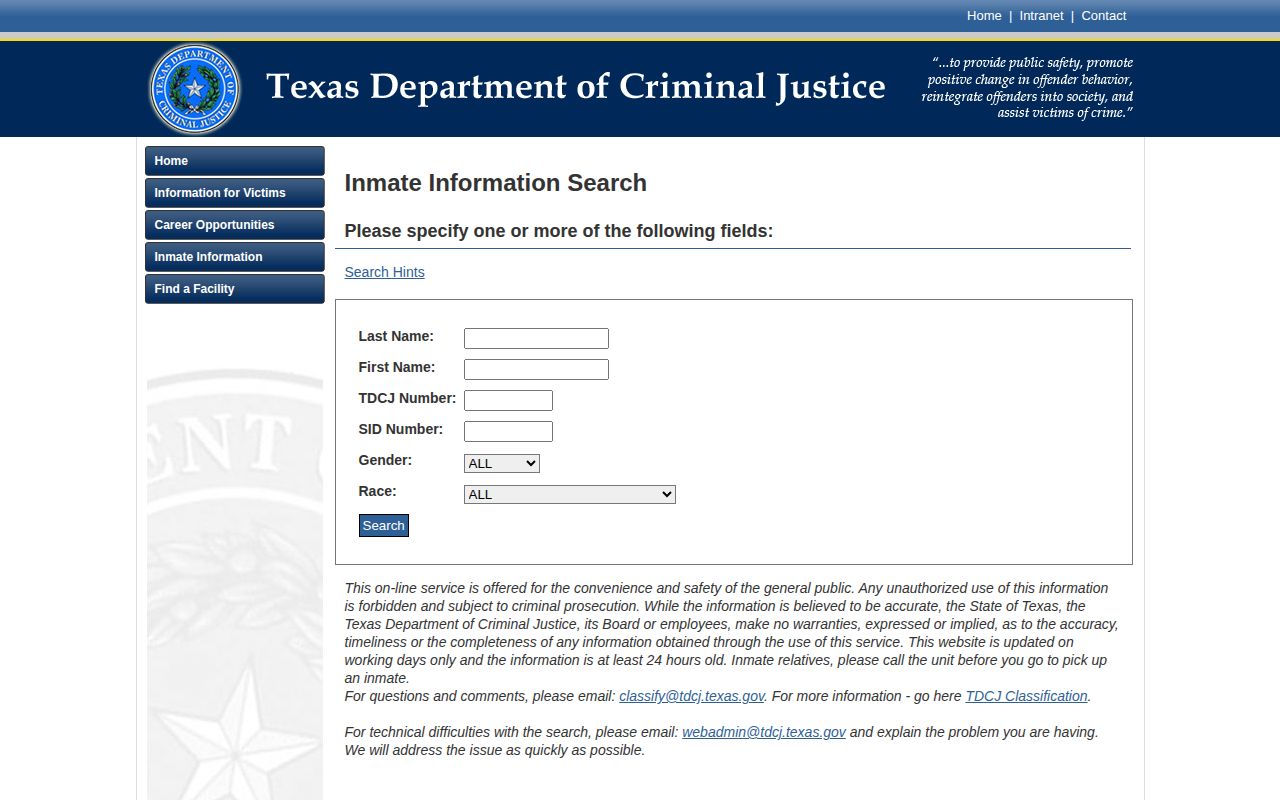
The form belongs to the state-prison system, so a Carson jail-only release still requires Carson and Armstrong records.
Armstrong Recent Release Checks
Neither official county site publishes a 24-hour or 72-hour release list, online roster, released-photo gallery, update schedule, or sheriff app. Texas IVSS-Counties is a specific-person status and alert tool. It must not be relabeled as a daily release list. For a date range, ask Carson whether an existing release log or database extract is maintained. The Public Information Act does not require the jail to create a new report.
A useful request names the date range and asks for existing booking-out or release entries, including time, release type, destination, and code definitions. An older event is better traced through the Armstrong court file and a written Carson request because a current notification search may no longer show the person.
Armstrong Post-Release Supervision
Parole and mandatory supervision follow TDCJ prison release and are managed by the TDCJ Parole Division. Armstrong maps to the Amarillo District Parole Office, though the approved residence can affect actual assignment. Probation is court-ordered community supervision handled by the Potter, Randall and Armstrong Counties Community Supervision and Corrections Department. There is no public statewide person-by-person probation locator.
An active TDCJ record showing parole or mandatory supervision means prison custody ended while the sentence remained under supervision. It is not the same as discharge. The Armstrong judgment and supervision order establish probation. The Parole / Probation resource separates the Amarillo reporting, voting, and local supervision offices.
Armstrong Release Alerts and Transfers
Texas replaced county VINE with IVSS-Counties on September 1, 2025. Armstrong and Carson sheriff pages still carry legacy VINELink links, but current action should begin at IVSS-Counties. Search by full or partial name, DOC ID, SID, jail ID, or permanent booking number. Alerts may cover booking, release, death, escape, transfer to TDCJ, and participating court events. The portal warns that its data is not an official record and that a former detainee may disappear.
Federal systems have narrower roles. The BOP Inmate Locator covers federal prison records and often shows a release date for a former federal inmate. “Not in BOP Custody” does not rule out another custodian or federal supervision. ICE’s locator concerns current and some recent immigration detention, while USMS often uses partner jails for federal pretrial custody. Check them only when a detainer, writ, docket, or transfer record points there.
Armstrong Custody Status Sources
Each system answers a different question. Match the source to the agency responsible for the event and record the retrieval date for any changing result.
| Status or event | Best source | Limit |
|---|---|---|
| Currently held for Armstrong | Carson Jail phone and IVSS-Counties | No official online local roster exists |
| Left Carson custody | Carson booking-out or release record | May represent transfer, not community release |
| Reason the local case ended custody | Armstrong signed court record | Does not prove the processing minute |
| In Texas prison or on state parole | TDCJ search and records | Not for an ordinary county bond-out |
| Federal prison release | BOP locator | Only BOP custody |
| Current immigration detention | ICE locator | Not a permanent release archive |
Question: Does “out of custody” prove a person is free? No. It proves only the limits of that status source. Ask for the destination and check the next custodian.
Armstrong Release Locations
Carson County Jail is the operating custody jail for Armstrong detainees. A person may leave it for the community, probation, TDCJ, another jail, or another sovereign. Armstrong County Sheriff’s Office / former local jail site is the arrest and records layer in Claude, not the current holding jail.
This geography matters. Court and arrest records are centered in Claude, while present custody and physical release processing occur in Panhandle. No official release door, release hour, transportation option, family waiting area, property procedure, or weekend policy was found in the official sources reviewed on August 2, 2026. Call Carson at 806-537-3511 before travel.
Armstrong Jail History and Releases
The old stone jail in Claude is part of Armstrong County history, not the current release point. The Texas Historical Commission marker describes a 1953 stone jail built with stone from an 1894 jail, which had replaced an earlier frame calaboose. The operational fact is the county’s current statement that its inmates are housed at Carson County Jail. Historical images or markers cannot be used as evidence of present custody.
Armstrong Commissioners Court archives list a Carson Jail Contract and monthly sheriff reports. That record supports the administrative arrangement. It also reinforces why one complete release inquiry may cross county lines: Carson holds the exit data, while Armstrong retains the local arrest and court trail.
Before relying on an old result, recheck the Armstrong custody notice, Carson contact page, IVSS portal, and TDCJ status. Custody contracts, office details, and live records can change. A current agency response should control over an undated copy or an old search capture.