
No Armstrong County 72-Hour List
The official Armstrong and Carson sources reviewed as of August 2, 2026 do not publish a rolling three-day release view. They also do not state an update cadence, online retention window, photo policy, or release-list app feature. The Armstrong County Sheriff instead states that all county inmates are housed at Carson County Jail and gives 806-537-3511 for inmate information.
This page therefore does not present names or imply that a local list exists. The 72-hour period is a practical range for collecting records from several days. Carson's release or transfer record establishes when its custody ended. Armstrong's court material can explain whether bond, dismissal, judgment, time served, community supervision, or another order affected the case.
Review Three Days of Armstrong Releases
Prepare a separate line for each person or booking being checked. A date range helps the custodian locate existing records, but the request should remain tied to identifiable bookings rather than demand creation of a new public list.
- Call Carson County Jail at 806-537-3511 with the full name and any date of birth, arrest date, booking number, or Armstrong case number.
- Ask whether the person left Carson during the date range, the exact recorded time, and whether the event was release or transfer.
- Check Texas IVSS-Counties and preserve any status-change alert with its retrieval time.
- Request Carson's existing booking-out, release, or transfer record, including the destination field and definitions for any codes.
- Obtain the relevant signed order, judgment, bond paper, or docket material from the Armstrong County and District Clerk.
- If Carson names TDCJ or another custodian, continue with that agency rather than calling the transfer a community release.
The Released Last 24 Hours page is the tighter path when the question concerns today's activity. The 72-hour method is better for reconstructing several days without claiming that the county maintains a rolling feed.
Armstrong Weekend Release Checks
A three-day range can span Friday through Monday or cover an office closure, but no official Carson weekend or holiday release rule was found. Do not infer that an order signed on one day caused physical departure at once. Jail staff may need to receive the order, clear other holds, record the event, and complete local processing.
Armstrong's combined County and District Clerk keeps public hours from 8 a.m. to 6 p.m. Monday through Thursday, remains open through lunch, and is closed Friday. That schedule can affect when a researcher obtains the court layer, not when Carson must release a person. Call the clerk in advance with the case number and approximate date because the official clerk page says the office has no general duty to search public records.
Note: The three-day range catches records across a closure, but only Carson can confirm the actual jail departure time and destination.
Fields for an Armstrong 72-Hour Review
No official feed fields are available to describe. The table instead identifies the release-record fields that can make a multi-day review reliable when the custodian holds them.
| Field | Role in the three-day review |
|---|---|
| Person and booking identifiers | Separates people with similar names and distinguishes more than one custody episode. |
| Admission date and time | Shows which jail stay corresponds to the Armstrong arrest. |
| Release date and time | Places departure within or outside the selected 72-hour range. |
| Release reason or type | Indicates the recorded route, subject to the custodian's code definition. |
| Destination or receiving agency | Separates community release from transfer into continued custody. |
| Charge, court, bond, or hold reference | Points to the Armstrong file or another authority that explains the event. |
Not every field must be public in every matter, and Armstrong does not publish a local data dictionary. Ask for the fields and the code sheet if one exists. Do not state that every response will contain them or translate an unexplained abbreviation into a legal conclusion.
Reconcile Each Armstrong Custody Event
A multi-day review is most useful when it treats each source as a layer. A live call gives the fastest orientation. IVSS can provide a status snapshot or alert. Carson's time-stamped record documents the jail exit. The Armstrong court file supplies the judicial basis. Those records may carry different times without truly conflicting.
For example, a bond order authorizes a route out of custody but does not prove when processing ended. A time-served docket entry needs the signed judgment and jail record. A transfer entry must be followed to the receiving agency. If TDCJ receives the person, its offender search or incarceration history becomes the state-custody source. A later parole, mandatory-supervision, or discharge event is separate from Carson's transfer.
The same scope rule applies to federal systems. BOP's “Not in BOP Custody” language concerns BOP only, and ICE locator absence is not an Armstrong release record. Use those sources when the case facts point to federal or immigration custody, not as routine substitutes for the jail and court records.
Why Armstrong Names May Vanish
Armstrong County has no local roster from which a released name drops off. Carson does not publish a 72-hour feed, and the current IVSS portal warns that people no longer in custody may not appear. A lost result can also come from incomplete agency data, a spelling issue, a transfer, protected information, or a search error.
That is why three days of missing results cannot be converted into a release list. Call Carson and ask for status and destination. If staff report release, obtain the booking-out record. If staff report transfer, follow the named receiver. Then use Armstrong's court file to identify the order or disposition connected with the custody change.
Three-Day Visibility Is Not Retention
A web window and legal retention are different concepts. No Armstrong or Carson source promises that a release appears online for 72 hours because neither county publishes such a feed. Texas Local Schedule PS item PS4200-10 covers prisoner incarceration records, including booking-in, booking-out, transfer, and release material, with a minimum retention period of release or transfer plus two years.
That rule supports a later targeted request, but it does not require online display for two years or any period. A pending request, lawsuit, audit, or other hold may also affect destruction. Sealed, expunged, juvenile, medical, and other protected material may be withheld or redacted under applicable law.
Request Three Days of Armstrong Records
For one person, request the electronic booking-in and booking-out, release, or transfer record for the identified booking, including date and time, release type, destination, and code definitions. Give the full name, date of birth when known, approximate arrest or booking date, and Armstrong case number. This describes existing material instead of asking Carson to answer “who was released” or create a new report.
The Carson Sheriff page lists Sheriff Tam Terry, P.O. Box 972, Panhandle, TX 79068, 806-537-3511, and fax 806-537-3514. Call to verify the current submission channel. Armstrong Sheriff can receive a separate request for its arrest, offense, booking, or transport material, while the combined clerk holds the court records.
The official Carson page shown below is the source for jail contact and also demonstrates why there is no local release control to click.
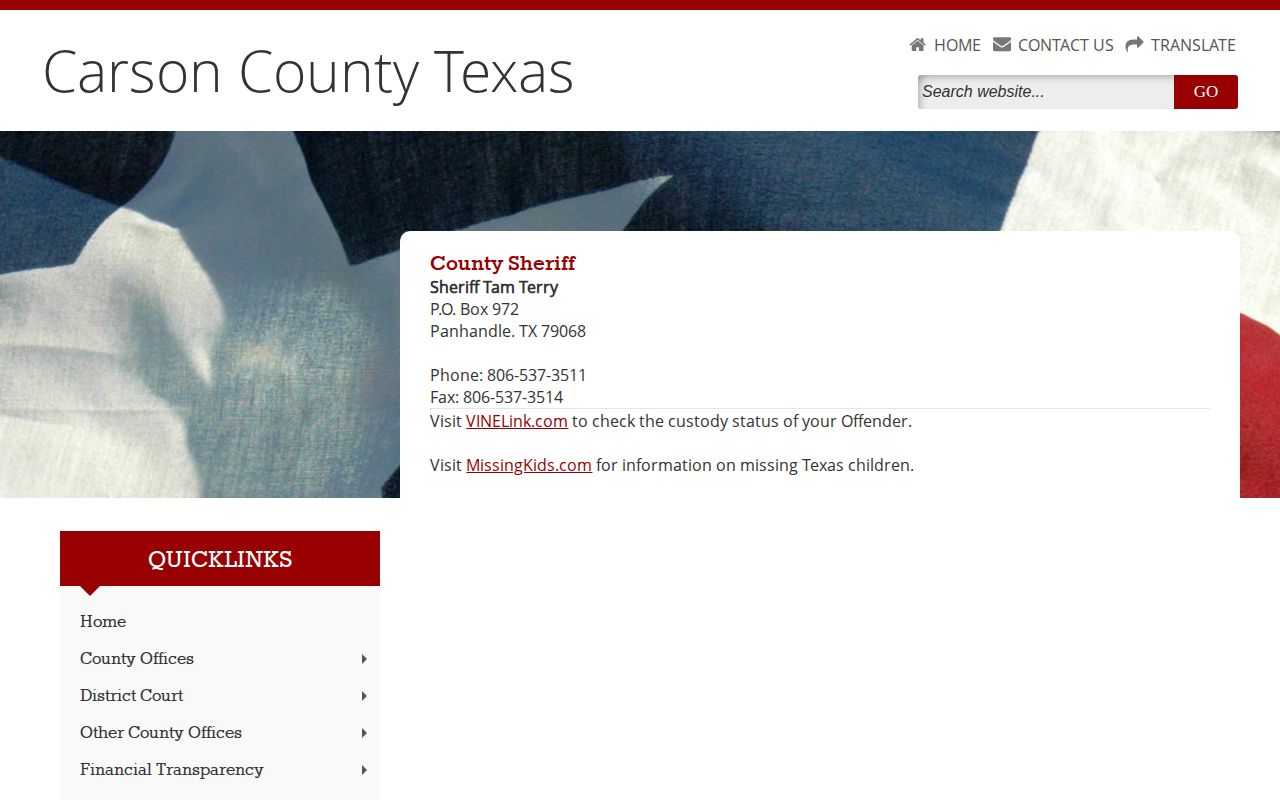
The captured source supports the direct-contact route, not a claim that Carson offers a hidden online release list.
Released or Still Held After 72 Hours
A person still held at Carson can be confirmed through the jail and, when available, current IVSS information. A person who left should be documented through the release or transfer record and the related court file. The Armstrong County named-person search covers the longer path when the three-day range does not resolve identity, disposition, or later custody.
Keep the retrieval date with dynamic results. A person can be released, transferred, returned on a warrant, or moved again during the same 72-hour span. Historical wording should therefore state what the dated record shows rather than present a past release as a permanent current status.